
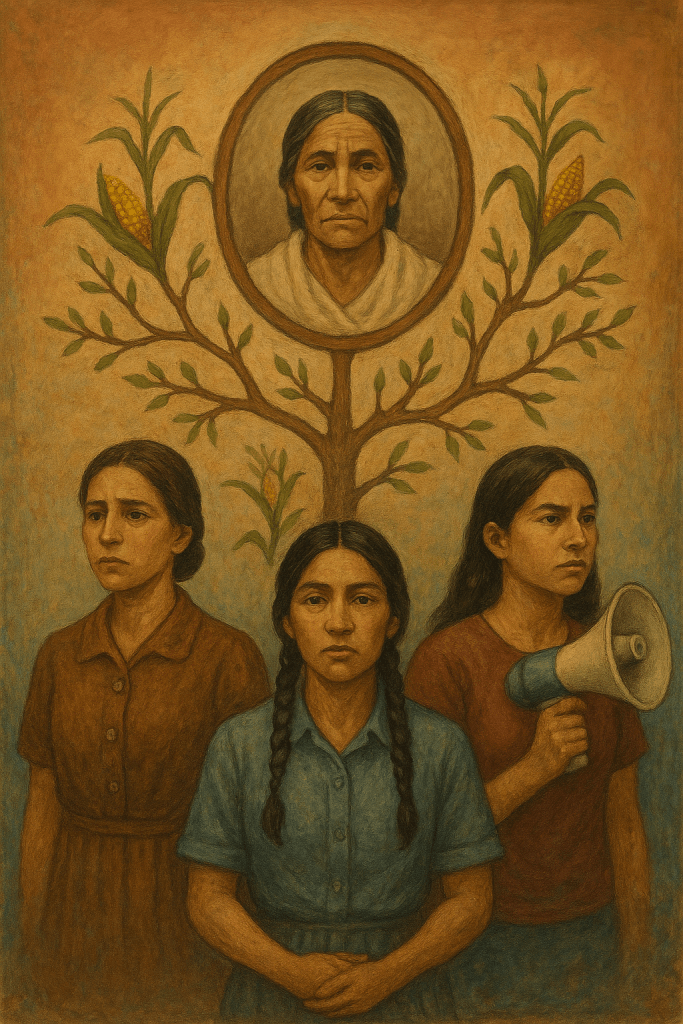
María – The Root
María lived quietly, but the land remembered her.
She was born in a house made of adobe and memory, where the walls held the scent of mesquite smoke and the echo of songs sung long before borders had names. Her grandmother said the land was sacred because it had never forgotten who danced on it first.
In 1847, María’s family was Mexican. In 1848, they were something else. The Treaty of Guadalupe Hidalgo drew a line through their lives, slicing the land into “ours” and “theirs.” No one moved. But suddenly, their home was Texas. Their language was foreign. Their customs were suspect.
María didn’t fight with fists. She fought with seeds. She planted maize in defiance, whispered Nahuatl under her breath, and told stories that refused to be erased. Her resistance was quiet,
but it grew. Every time she pressed her hands into the soil, it felt like she was asking the earth to remember her.
The land remembered.
Elena – 1930s Mexican Repatriation
“They said we weren’t supposed to be here. But my birth certificate says Los Angeles. My schoolbooks say California. My heart says María. And María said the land remembers. So why are they putting us on trains like we’re strangers?”
Elena was twelve when they came. She stood at a train station clutching her little brother’s hand, her knuckles white with fear. Around her, families were being loaded onto trains headed south—deported from a country they were born in. Over two million people, many of them citizens, were repatriated during the 1930s.
She didn’t understand why her mother cried so quietly, or why her father stared at the ground like it had betrayed him. She just knew it felt like exile.
She whispered María’s stories into her brother’s ear. About rivers that don’t obey. About seeds that grow even in stolen soil. She told him, “We belong. Even if they forget, the land remembers.”
The land remembered.
Rosa – 1954 Operation Wetback
“They came for my father while he was picking tomatoes. Didn’t ask for papers. Didn’t care that he’d lived here longer than the sheriff. They called it Operation Wetback like it was a joke. Like we were water to be drained.”
Rosa was sixteen. She watched her father disappear behind the blur of flashing lights and dust. Her mother didn’t scream—she just braided Rosa’s hair tighter and said, “We stay. We fight. We remember.”
That night, Rosa found María’s photo in the drawer. Her eyes looked like hers. Her silence felt familiar. But her roots—they were louder than any border.
In 1954, over a million people were deported under Operation Wetback. Rosa learned that erasure doesn’t always come with violence—sometimes it arrives with paperwork, a bus, and no goodbye. But she also learned that memory is a kind of armor. And grief, when shared, becomes resistance.
The land remembered.
Xochitl – Present Day, Project 2025
“They call it Project 2025. I call it a blueprint for erasure. They want to deport millions, dismantle asylum, erase sanctuary. But I’ve read María’s stories. I’ve marched with her memory. I’ve planted her maize in community gardens across the city.”
Xochitl stands outside a detention center with a megaphone. Her voice shakes, but she doesn’t stop. Around her, organizers chant in English, Spanish, and Nahuatl. She’s not just protesting—she’s remembering.
She thinks of María every time she sees a child behind a chain-link fence. She thinks of Elena when she hears the word “repatriation.” She thinks of Rosa when she sees a father handcuffed in front of his children. And she stands for her unborn daughters:
“Your future will see peace.”
The buses behind the fence are part of a machine that’s been running for centuries. But this time, María’s story is part of the resistance. Her memory lives in the chants, the murals, the petitions. Her quiet defiance has become a movement.
The land remembers.
The Land Remembers
María never called herself an activist. She called herself a mother. But every seed she planted, every story she told, was an act of resistance.
And now, her descendants speak with her voice. Across generations, across borders, across attempts to erase them—they remain.
Because the land remembers.
And so do they.
And so do we.
Closing Note
Though María is a fictional matriarch, her story is stitched from the lived experiences of countless Mexican and Native American families whose histories have been marked by displacement, resistance, and remembrance. Her voice carries the echoes of real women who planted seeds in stolen soil, who braided memory into survival, and who refused to be erased.
This is for them—for every generation that stayed, fought, and remembered.

 A Call To Action